Autobiographical Narration and Female Authorship in Spanish Exile after 1936
Among the women who fled Spain during the Civil War and the Franco dictatorship, there were countless intellectuals and artists. A large part of this group's writings has been (re)published thanks to the work of the GEXEL research group and publishers such as Renacimiento. However, their discussion in research remains centred on a few celebrities such as María Zambrano. Our project will change this by thoroughly analysing a large corpus of autobiographical writings by women in exile. This corpus will allow us not only to reconstruct the lives, creations and worldviews of these authors, as existing research on these works already does, but also to examine female authorship before, during and after exile as the subject of their works and as a pattern of their production, publication and reception practices, with particular attention to intersectional factors of authorship, such as age, class, migration, education, gender, family situation and health.
Goals
- Consolidate the corpus and feed its metadata into a database. This should improve the public availability of data on exile, make the authors and artists living in exile visible as such and help to further reduce possible intersectional national and gender-related bias in exile research. The database is freely accessible according to FAIR principles and can be used for further research on exile, female authorship or 20th century art, literature and philosophy.
- Analyse the production, dissemination and reception of the elements of the corpus. On the basis of references to the elements (including reviews, correspondence, interviews) as well as editions and translations, the aim is to reconstruct how autobiographical writings by women in exile are disseminated – or even forgotten. In addition to these two endeavours, which are oriented towards the ideal of completeness.
- For a sample of texts with a strong reference to Mexican exile, digitise the materials and make them available for Named Entity Recognition and thematic modelling so that intertextual and metapoetic references can be reconstructed, contributing to both a general idea of authorship and the specific authorship of women writers and artists.
- Using the same sample, model the themes and processes of female autobiographical writing in exile and examine them in depth at nodal points such as the categories of art, exile and medium or the processes of self-representation.
The result is a better understanding of female authorship in exile and autobiographical writing in exile, both of which are explored using the Spanish exile as a model.
Project Members
Matei Chihaia is Full Professor of Spanish and French Literature and Member of the Center for Narrative Research.
Mirjam Leuzinger is a postdoctoral researcher and Privatdozentin in Romance literatures and cultures. Her work focuses on exile, autobiography, and intellectual history across Latin America and Europe.
Associate Professor at the International University of Valencia (VIU), Andrea Luquin Calvo specializes in the intellectual legacy of the Spanish exile of 1939, with a particular focus on its authors and artistic expressions. Her research also engages deeply with feminism and gender studies.
Jaqueline Rolón is a PhD candidate at the National University of La Plata (UNLP) and research assistant at the University of Wuppertal. Her research focuses on Argentine young adult literature and its intertextuality with mythology.
Research Ecosystem
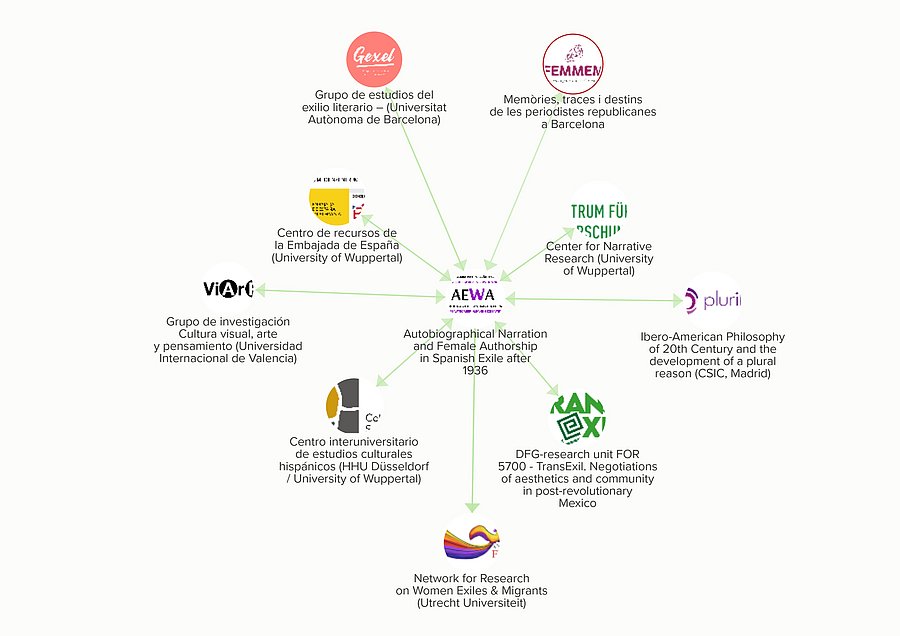
Cooperation partners
News
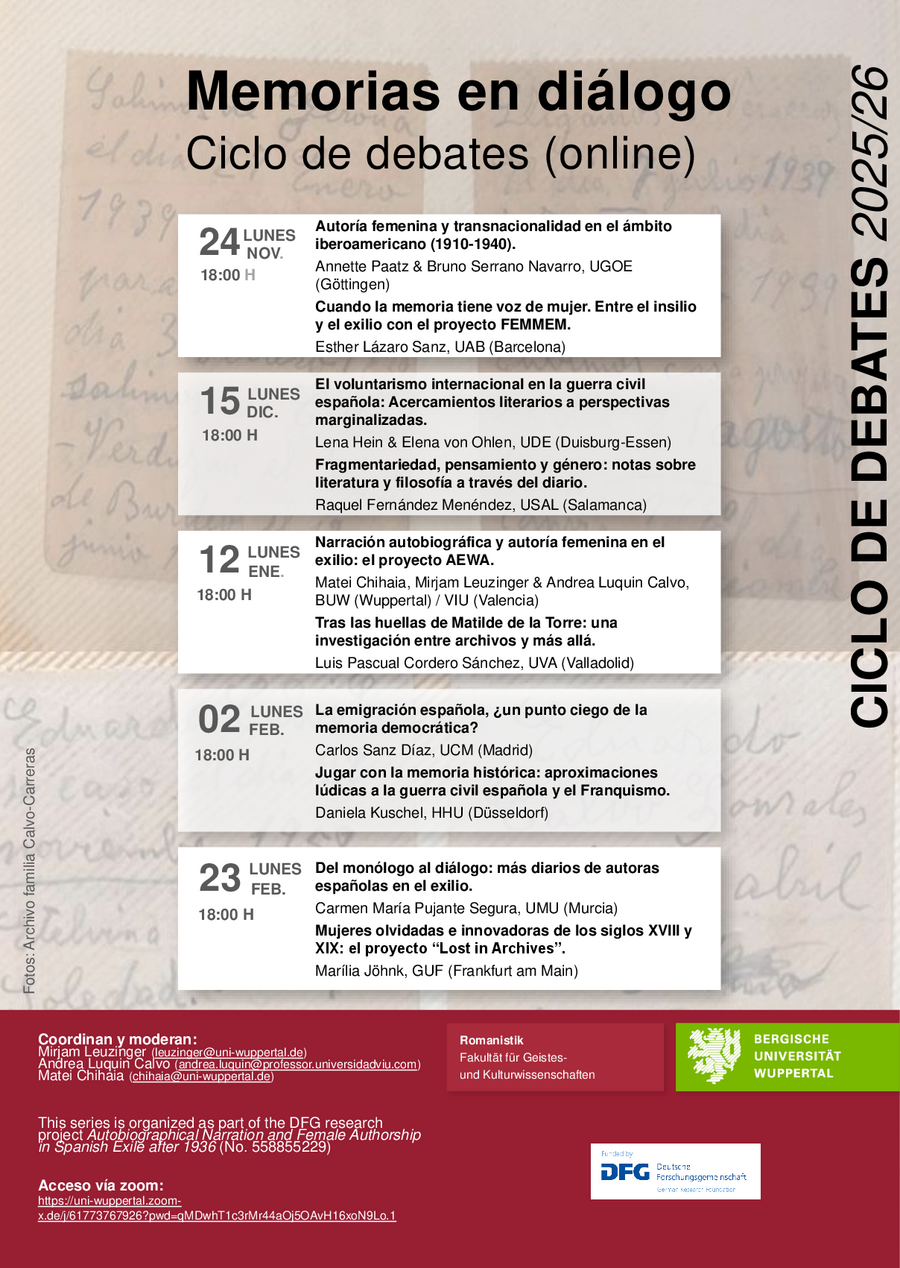
Enlace al encuentro "Memorias en diálogo"
Ver también el Blog de AEWA

DFG Projektnummer 558855229
Mehr erfahren über